
9 API Security Best Practices Every Developer Must Know

We as developers have seen firsthand how much of modern software truly runs on APIs. Over the past 14 years of working as a Senior Developer, I have always focused on the bigger picture while building large scale enterprise applications, and APIs consistently emerge as one of the most critical pieces of building any system. You can imagine them as the connective tissue of applications, which enables systems to talk to each other and scale globally, and can easily evolve with business needs. But as APIs empower communication between the systems, they also introduce a unique set of security challenges.
And it does not matter whether you see it from a Technical architect’s perspective or a developer's, we should always consider some important questions like securing the API while making the API scalable to a million users? Or how do we enforce standards, security, and versioning across the organization?
Emphasizing the security aspects of the API is critical, and in my career, I’ve had the opportunity to handle these challenges and achieve success. I’ve worked on designing APIs that had to survive real-world scale, while also securing the endpoints. Those experiences have shaped my impression of treating APIs as products, and not just interfaces and the importance of securing them.
That’s why I’ve put together these 9 API security best practices, which are not just some abstract theory, but are the lessons distilled from years of building, integrating, and scaling APIs. I will try to capture the dual responsibility of carrying and securely delivering APIs that are technically sound, secure, and future-proof, while also making them intuitive, reliable, and developer-friendly.
So without wasting any time, let’s discuss these 9 API security Best Practices.
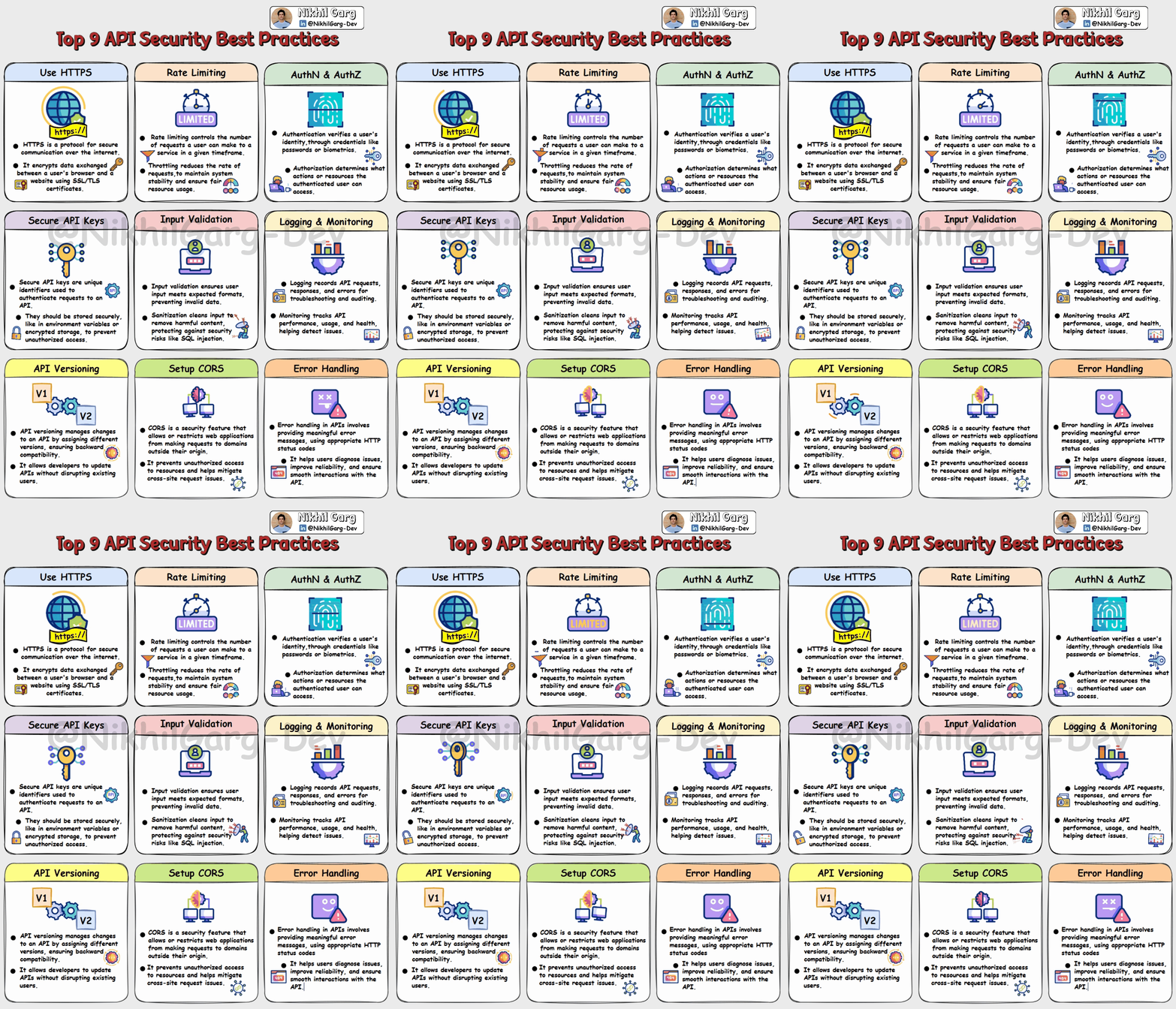
1. Use HTTPS Everywhere
While building an API using plain HTTP is not at all secure. It is just like shouting your password in a crowded room. As we know APIs exchange sensitive data such as passwords, tokens, and critical information like payment details, the need for encryption is non-negotiable. That is why using HTTPS is of utmost importance. It protects against eavesdropping and man-in-the-middle attacks. So one of the best practices is to force HTTPS, and enable HSTS (HTTP Strict Transport Security).
For example your banking login PIN is encrypted end-to-end so no one can sniff it over public Wi-Fi.
2. Implement Rate Limiting
Without Rate Limiting APIs are open to various threats. Even a single user can bring down your system by overloading it with fake requests. Think it like a restaurant and without imposing any limits, one greedy client can overload the kitchen. That is why implementing Rate limiting is pivotal as it shields APIs from brute-force logins and DDoS floods. The best practice is implementing Set per-user, per-IP, or per-key thresholds. Queue excess requests.
Take for example the case of using banking apps. In this case we can rate-limit login attempts to prevent credential stuffing.
3. Strong Authentication & Authorization
The concept Authentication and authorization again provides the necessary checks of who is accessing, while Authorization checks what the user can do. Get either of this wrong, and your API is wide open. That is why strong Authentication and Authorization should be implemented to prevent account takeovers and privilege escalation. Some of the best practice is to use OAuth 2.0, JWT, and role-based access control (RBAC).
Take an example of a banking system where a user can view transactions, but only bank admins can modify loan records.
4. Secure API Keys
Securing your API keys is another important aspect we should focus on while building any API. Think API keys as the keys to your house, if you lose them, then anyone can walk into the house, such is the case with the API keys if they are compromised any one can access the system giving attackers free access. The best practice is to store them in secret managers, never in code repos and rotate regularly.
Think of a scenario of a leaked payment API key that can let hackers charge unlimited transactions.
5. Validate and Sanitize Input
Another aspect of API security is validating and sanitizing the inputs. APIs take input from outside which gives attackers a good chance to inject malicious data. That is why it is important to block SQL injection, XSS, and command exploits. One of the ways to do so is to enforce strict input validation and sanitize everything.
A straightforward scenario can be preventing an attacker from sending "DROP TABLE users;" through a query field.
6. Logging & Monitoring
Logging and monitoring are as important as any other aspect of securing the API. If you don’t log, you’re flying blind. By implementing the right Logging and Monitoring techniques, it would help in detecting suspicious activity before it’s too late. So the best practice is to capture requests, errors and anomalies. For this, you can use tools like ELK and Datadog.
A good example of this can be detecting a sudden spike in failed ATM login requests, which may signal brute-force attacks.
7. API Versioning
As with every other thing, the Tech evolves too, and so should your APIs. But breaking old clients overnight is a recipe for chaos. So it is of utmost importance to keep existing apps working while you innovate. For this the best practice is to implement versioning in URLs (/api/v1/, /api/v2/) or headers, and deprecate gradually.
Take the example of Payment gateways, which often run multiple versions for smooth migration.
8. Configure CORS Properly
CORS decides which websites can talk to your API. And if you misconfigure it, the chances of attackers hijacking sessions would increase drastically. So, configuring CORS definitely matters because it could help in preventing malicious websites from exploiting already logged-in users. The Best practice here will be allowing only trusted origins and restricting methods.
For example, in a banking system scenario, your banking API should accept requests from bank.com, not any random domains.
9. Handle Errors Wisely
Handling Errors wisely is of utmost importance. You see, verbose error messages surely help the developers, but also the hackers. Imagine revealing stack traces or DB errors openly, which could hand attackers an easy roadmap. Here, the Best practice is to return generic messages to users and log details for devs. So, instead of exposing DB details, show internal server error.
Final Thoughts
APIs power everything today, from ordering food to streaming movies, and yes, even transferring money in your banking app. Every system implements the communication between them by using APIs. And by the end of this article, it is very clear that without proper security, those same APIs can become the weakest link in your system.
And by following these 9 API security best practices, which include implementing HTTPS and input validation to rate limiting and meaningful error handling, you must ensure that your APIs are safe and protect sensitive data like banking credentials, they are reliably handling high traffic without breaking, and lastly they should be resilient in detecting and stopping attacks before they spread.
Think back to that moment when you opened your banking app. Security is the reason in the first place that you trust it with your money. Start small, apply these tips today, and build APIs your users can rely on tomorrow.